
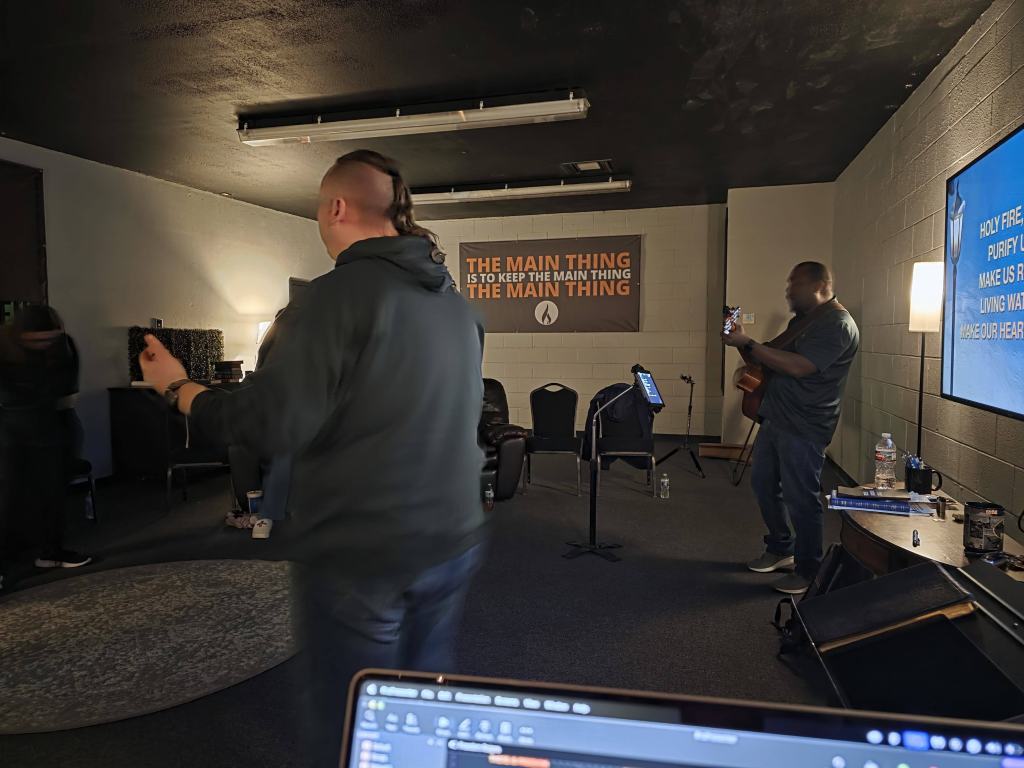
It was a great night in THP Students. We first kicked off with some great worship led by one of our worship team leaders, Carlos.







With it being the Christmas Season we kicked off a special 3 part series we are calling “The Gospel According to A Christmas Carol.”
ASK: How many you are familiar with the story of A Christmas Carol by Charles Dickens?
The story was written in 1843 and is essentially about an old, grumpy man, famously known as “Scrooge.” He is a very unhappy, old man who has built his life around trying to protect himself, because he believes that only one materialistic thing can keep him safe. He is often grumpy and bitter because he holds onto painful memories from when he was younger, choosing to be a selfish person who stays alone instead of risking getting hurt again. He believes the most essential things in life are business and profit, and he gets outraged when people try to point him towards Christ-centered activities rather than this materialistic thing he’s holding on to. Even though he acts polite in public at times and might even say he feels bad for people, his behavior is actually very selfish; he only ever thinks about what he can get or what he might lose. This complete focus on himself, rather than on others, is why he ends up so miserable and alone.
One night, he’s visited by the ghost of an old friend who lived the very same kind of life he did. He came back to warn him that if he didn’t change his ways, his fate was going to be the same as his. To help him learn, he told him that he would be visited by 3 Christmas Ghosts – Past, Present, and Future.
This reminded me of a particular passage in the scriptures. In Luke 16, Jesus tells the parable of a rich man and a poor man. When they die, the rich man is in agony and cries up to Abraham, begging for relief. When he found out that there was no relief from punishment in hell, he asked Abraham to send the poor man back to earth to warn his family. Abraham’s response…
But Abraham said, ‘They have Moses and the Prophets; let them hear them.’ And he said, ‘No, father Abraham, but if someone goes to them from the dead, they will repent.’ He said to him, ‘If they do not hear Moses and the Prophets, neither will they be convinced if someone should rise from the dead.’ ”
The Holy Bible: English Standard Version (Wheaton, IL: Crossway Bibles, 2016), Lk 16:29–31.
Transition Sentence: Abraham’s response is cold-hearted, but instead states a very simple fact. We have been given the warning, and it’s through the scriptures. Today, we begin a 3-part series on biblical Ghosts of Christmas. What would cold Ebeneezer and we learn?
In ” A Christmas Carol, Ebeneezer is first visited by the Ghost of Christmas Past. This ghost took Scrooge on a journey through time. It dind’t take him to see other people’s memories, but only to see his own past. They flew together and landed near a small village where Scrooge grew up. He watched himself as a lonely boy spending Christmas alone at a cold, empty boarding school.
Scrooge saw his little sister, Fan, come to bring him, and he saw his first job where his kind boss, Mr. Fezzziwig, threw a massive Christmas Party for all his employees. He also saw the saddest memory: the time his old fiancée, Belle, decided to break up with him. Scrooge had lost his focus. He began to put his focus on material things rather than what was important. This began to spill out in how he treated others. She realized that Scrooge had changed, and she realized that he had begun to care more about money and profit than about her.
In our lives, we experience both great things and bad things. The question becomes, what do you allow to define who you are?
Scrooge had a choice.
- He could allow the bad situations that happened to him to define who he was.
- Let his good memories define who he was.
- Let his mistakes define who he was.
We all face these same choices.
When faced with a terrible situation, Joseph of the Old Testament rises and begins to testify. Starting in chapter 37 of Genesis, Joseph’s story spans 14 chapters, testifying to us that the bad things in life don’t have to define us. He was betrayed by his family, abused, neglected, lied on, and left to suffer in prison. He had every right to be bitter and angry. Yet he did not allow that to dictate who he would be; he put his trust in God completely.
When faced with mistakes, the spirit of Peter of the New Testament rises and begins to share about his darkest day. The gospels all confirm how he denied Jesus publicly, even to the point of cursing someone out. He ran away scared. Even though he had once claimed to be a faithful follower and had boldly stood for the gospel, he found himself in a dark and dangerous place. But he’d also testify about how Christ forgave him, redeemed him, and restored Him. He would testify how, instead of allowing his failure to define his actions moving forward, he chose to live for Christ.
From the surface, it looks like the correct answer: “Let good memory define who we are.” But there’s a trap in that mindset too. For that, the spirits of two lonely disciples rise from Luke 24. They are traveling down the Road to Emmaus. They remember the happy times. They were in awe of the news of Jesus’ resurrection. But they are so focused on the past that they don’t realize Jesus is standing right there with them. Our memories of happy times are things we should point to and look to, especially in times of discouragement. But they should not be something we dwell on. They are meant to remind us that God has taken care of us in the past and will continue to do so. They are meant to give us a kind of pick-me-up to push us forward.
So what is the ultimate lesson for Scrooge and us? This is where the spirit of Paul rises out of the book of 2 Corinthians:
Therefore, if anyone is in Christ, the new creation has come: The old has gone, the new is here! 18 All this is from God, who reconciled us to himself through Christ and gave us the ministry of reconciliation: 19 that God was reconciling the world to himself in Christ, not counting people’s sins against them. And he has committed to us the message of reconciliation. 20 We are therefore Christ’s ambassadors, as though God were making his appeal through us….
The New International Version (Grand Rapids, MI: Zondervan, 2011), 2 Co 5:17–20.
What Paul is telling us is that our identity is not based on our Past in any fashion. It’s based on Christ. Who you are in Christ is all that matters. If we put our focus on Him, on the scriptures, and allow it to shape us and inform how we approach the world, people, and ourselves, then we will make it.
 Adventures in Student Ministry